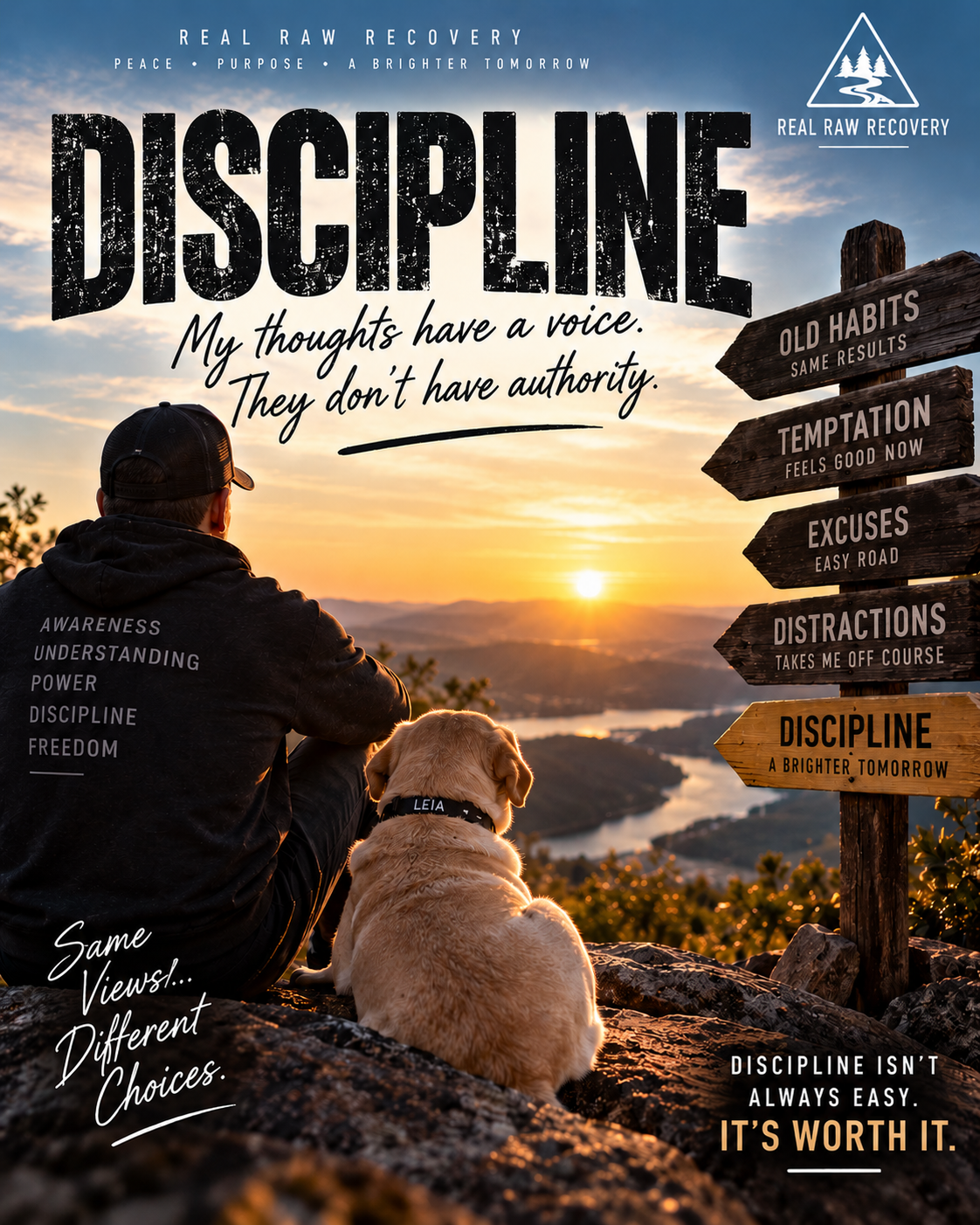
Discipline: My Thoughts Have a Voice. They Don’t Have Authority.
For a long time, I thought discipline was mostly about making myself do things I didn’t want to do.
Get up.
Go to work.
Exercise.
Handle responsibilities.
Follow through.
And yes, that’s discipline.
But recovery taught me there’s another side of discipline that may be even more important.
What about the things I really want to do—but know I shouldn’t?
What happens when the thought isn’t:
I don’t feel like doing this.
What happens when it’s:
I really want this.
This would feel good right now.
Just this once.
Nobody would know.
I deserve it.
What’s the big deal?
Now we’re getting somewhere.
Because there have been plenty of times in my life when I wanted something that wasn’t good for me.
Something that offered immediate relief.
Immediate pleasure.
Immediate escape.
Immediate validation.
And in that moment, my thoughts could make a pretty convincing argument.
Recovery didn’t eliminate those thoughts.
It changed my relationship with them.
Wanting Something Is Not a Command
This is important.
Having a thought doesn’t make me weak.
Wanting something doesn’t make me bad.
Feeling an urge doesn’t mean I’ve failed.
And pretending those thoughts and desires don’t exist isn’t discipline.
Awareness means I can acknowledge them without automatically acting on them.
I can say:
Yeah, I want that.
And then ask:
Where does that choice take me?
That’s a very different conversation.
There was a time when what I wanted in the moment carried enormous authority.
If something promised relief from discomfort, I wanted relief.
If something felt good, I wanted more.
If I was angry, I wanted to react.
If I was uncomfortable, I wanted to escape.
If I wanted something badly enough, my mind could usually manufacture a reason why having it made sense.
That’s why discipline in recovery goes much deeper than willpower.
Wanting something doesn’t mean I have to give myself permission to have it.
Awareness Has Changed
We’ve talked about awareness many times at Real Raw Recovery.
At first, awareness may simply be recognizing what’s happening.
There’s that thought.
There’s that association.
There’s that old language.
There’s that familiar pull.
That’s important.
But eventually awareness can move to another level.
I don’t just recognize the thought anymore.
I understand it.
I can become curious instead of immediately reactive.
Why is this showing up right now?
What am I actually feeling?
What association did my mind just make?
What is this thought promising me?
Relief?
Comfort?
Attention?
Escape?
Control?
And then comes the question that matters most:
Where does following this thought take me?
Now I’m no longer just experiencing the thought.
I’m observing it.
Understanding it.
And that creates something incredibly powerful.
Space
There is space between:
what I think
and
what I do.
There is space between:
what I want
and
what I choose.
That space changed my life.
Because I don’t have to immediately react to everything happening inside me anymore.
I can want something without having it.
I can feel something without acting on it.
I can experience discomfort without escaping it.
I can feel angry without giving anger control of my behavior.
I can have an old thought without making an old choice.
And I can absolutely not feel like doing something and still do it because I’ve already decided it matters.
That’s where both sides of discipline come together.
Sometimes discipline means doing something I don’t want to do because it serves the life I’m building.
And sometimes discipline means not doing something I desperately want to do because I understand the life it could take me back to.
Both require the same thing.
Choice.
Understanding Leads to Power
The more I understand what’s happening inside me, the less mysterious my behavior becomes.
I begin recognizing patterns.
I begin recognizing associations.
I begin recognizing the language that used to precede certain choices.
And once I can see what’s happening, I’m no longer standing there helplessly watching it happen.
I have options.
That’s power.
Not the power to control every thought that enters my mind.
Not the power to eliminate every desire.
Not the power to prevent myself from ever feeling angry, lonely, frustrated, afraid, attracted, tempted, tired or uncomfortable.
That’s not what I’m looking for.
I’m interested in something much more useful.
The power to decide what happens next.
And that’s where discipline comes in.
My Thoughts Have a Voice. They Don’t Have Authority.
I don’t need to fight every thought.
I don’t need to argue with it.
I don’t need to be ashamed of it.
Sometimes I simply need to recognize it.
I hear you.
Maybe I even understand exactly why you’re here.
But understanding a thought doesn’t require following it.
My thoughts get a voice.
My emotions get acknowledged.
My desires get acknowledged.
My circumstances get considered.
But they don’t automatically get the final vote.
I do.
That’s discipline.
And sometimes my disciplined choice is to push myself.
Sometimes it’s to rest.
Sometimes it’s to speak.
Sometimes it’s to shut the hell up.
Sometimes it’s to stay.
Sometimes it’s to leave.
Sometimes it’s saying yes to something difficult because it moves me forward.
And sometimes it’s saying no to something incredibly appealing because I already know where it leads.
Discipline isn’t always choosing the harder option.
It’s choosing the option that aligns with who I’ve decided to become.
From Accountability to Discipline
Last week we talked about accountability.
Behavior doesn’t lie.
We looked at our actions rather than our intentions.
We talked about owning our choices, keeping our word to ourselves and building evidence that we can trust ourselves again.
Discipline takes us underneath that behavior.
If I make a choice that doesn’t align with the life I’m building, I can ask:
What happened right before it?
What was I thinking?
What was I feeling?
What did I want?
What story did I tell myself?
What was I trying to avoid?
What was I trying to get?
Now accountability isn’t just showing me the behavior.
Awareness is showing me the road that led there.
And once I can see the road, I have a better opportunity to choose another direction.
Awareness → Understanding → Power → Discipline
This progression has become incredibly important to me.
Awareness allows me to recognize what’s happening.
Understanding allows me to see why it’s happening and where it could lead.
Power is recognizing that I still have a choice.
Discipline is making that choice based on the life I’m building—not simply the thought, feeling or desire I’m experiencing in the moment.
That’s transformation.
Not never having another unwanted thought.
Not never wanting something that’s bad for me.
Not becoming some perfectly disciplined person who wakes up every morning excited to do everything he should.
That’s bullshit.
I’m human.
Thoughts will come.
Desires will come.
Excuses will come.
Discomfort will come.
The difference today is that they don’t have to become instructions.
Discipline Creates Freedom
People sometimes hear discipline and think restriction.
I see the opposite.
There was nothing free about being controlled by whatever I wanted in the moment.
There was nothing free about needing immediate relief every time I became uncomfortable.
There was nothing free about repeating behaviors simply because a thought told me they would make me feel better.
Freedom is having the ability to want something and still choose.
Freedom is being uncomfortable and still choosing.
Freedom is being tired and still choosing.
Freedom is being tempted and still choosing.
Freedom is realizing:
I don’t have to do everything my mind suggests.
That’s not deprivation.
That’s power.
Look Deeper
So this week, don’t try to control every thought.
Notice them.
Listen.
Get curious.
Understand what they’re asking for.
Then ask yourself:
Where does this thought want to take me?
Does that destination align with the life I’m building?
And if it doesn’t?
You don’t have to hate the thought.
You don’t have to hate yourself for having it.
You simply don’t have to follow it.
Because every thought that enters our minds doesn’t deserve a vote on how we live our lives.
Our thoughts have a voice.
We have the authority.
Awareness. Understanding. Power. Discipline.
Look deeper.
Mike
Real Raw Recovery
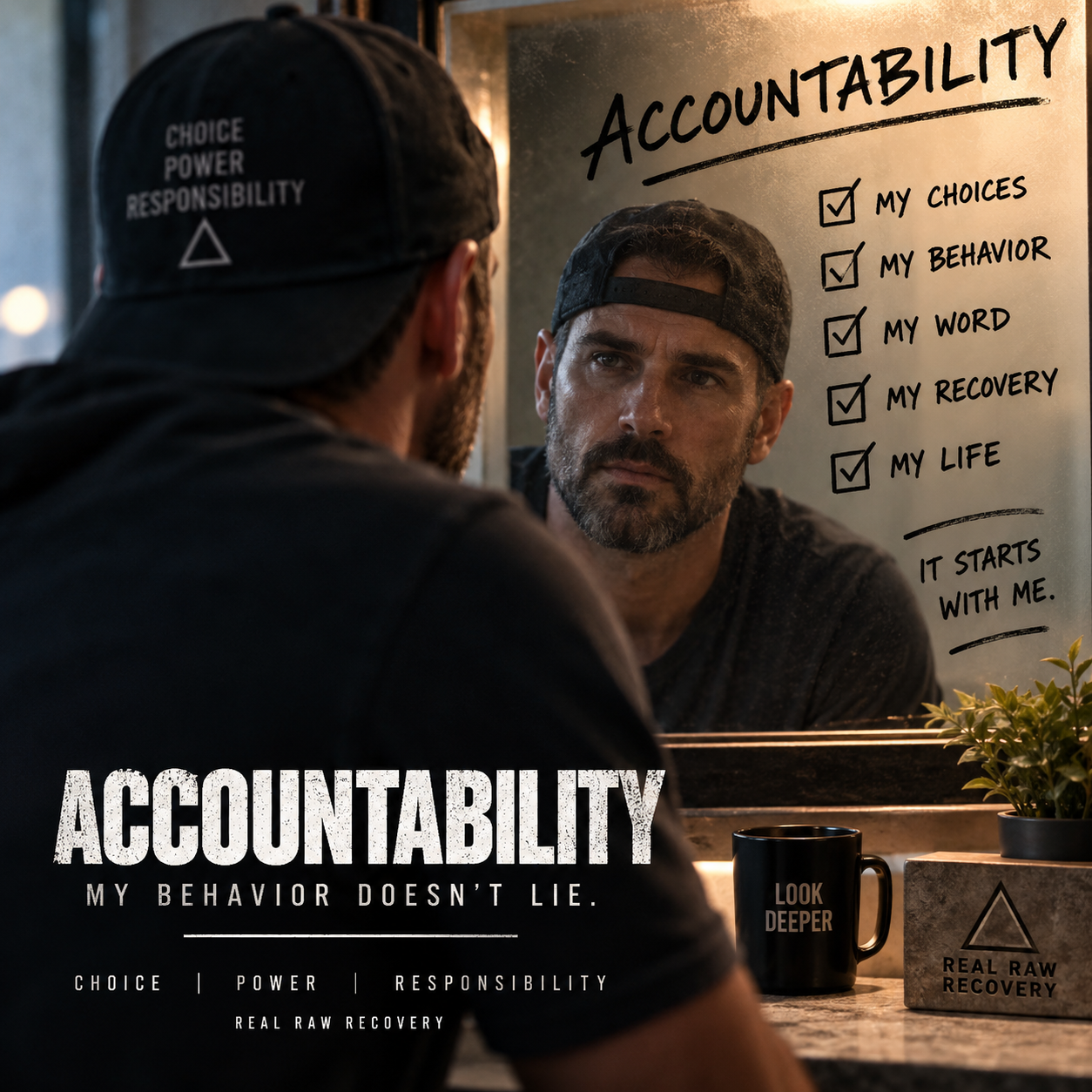
Accountability: Your Behavior Doesn’t Lie
Over the past several weeks, we’ve talked about trust, integrity, authenticity and self-compassion.
We’ve talked about taking off the mask.
Forgiving ourselves.
Learning from our mistakes without allowing those mistakes to become our identity.
Recognizing that we are worthy of love even while we’re still growing.
All of that matters.
But eventually, recovery asks us a much more direct question:
Now what are you going to do?
Because at some point, reflection has to become action.
Understanding has to become behavior.
And the person we say we’re becoming has to start showing up in the choices we actually make.
That’s accountability.
And maybe it’s time for Real Raw Recovery to get a little more raw about it.
Nobody Is Coming to Hold Me Accountable
When we hear the word accountability, we often think about somebody else.
A sponsor.
A therapist.
A counselor.
A meeting.
A partner.
A boss.
Someone checking whether we did what we said we were going to do.
Those things can be valuable, especially in recovery.
But that’s not the accountability I’m talking about.
Because eventually, I have to reach a place where I don’t need someone standing over my shoulder to make sure I’m living the life I said I wanted.
At the end of the day, there’s one person I have to answer to.
The person in the mirror.
Did I do what I said I was going to do?
Did my choices align with what I say matters to me?
Did I show up when it was inconvenient?
Did I follow through when nobody would have blamed me for taking the easier option?
Because here’s the raw truth:
My behavior doesn’t lie.
I can tell myself whatever story I want.
My choices will tell me what I actually prioritized.
When Nobody Would Blame
Choice. Power. Responsibility.
This is where the Real Raw Recovery Triangle becomes more than a logo.
Choice. Power. Responsibility.
I’ve made a lot of choices in my life.
Some I’m proud of.
Some I’m not.
Recovery didn’t suddenly give me the ability to make choices.
It taught me to make different ones.
Today, I make choices for me.
Not selfish choices.
Choices that protect the life I’m building.
Choices that support my recovery.
Choices that allow me to look in the mirror and know my behavior is beginning to match the person I say I’ve become.
That’s power.
And responsibility means owning those choices.
Not blaming circumstances.
Not pretending I had no options.
Not beating myself up when I get something wrong.
Just being willing to say:
That was my choice. What am I going to choose now?
Accountability Is Bigger Than Showing Up
Accountability isn’t only getting to work on time, paying bills, keeping appointments or doing the everyday things we’re supposed to do.
Those things matter.
But I’m accountable for something much bigger.
I’m accountable for the principles I say I live by.
If I say resilience matters, then I’m accountable for how I respond when life knocks me backward.
If I catch myself using language that no longer aligns with my recovery, I’m accountable for noticing it and reframing it.
If I say boundaries matter, I’m accountable for maintaining them when they’re uncomfortable.
If I say integrity matters, I’m accountable for making the same choices when nobody is watching.
If I say I trust myself, I’m accountable for making choices that give me a reason to continue trusting myself.
If I say I’m living authentically, then my private behavior needs to resemble the person I’m presenting to the world.
If I believe in self-compassion, then I’m accountable for correcting myself without destroying myself.
Everything we’ve talked about comes back to this.
Knowing the principle isn’t enough.
Eventually, I have to live it.
Recovery Has Some Catching Up to Do
Here’s another part we shouldn’t sugarcoat.
If we’re doing this work, there’s a good chance there was a period in our lives when responsibility wasn’t exactly our strongest quality.
Maybe other people carried things we should have carried.
Maybe promises were broken.
Maybe responsibilities were ignored.
Maybe we blamed circumstances, substances, relationships, childhood, stress, anger or everybody around us.
Some of those circumstances may have been very real.
They still don’t get to build our future.
And sometimes, yes—
we have some catching up to do.
That’s not shame.
That’s reality.
Recovery doesn’t erase the consequences of yesterday.
It gives us the opportunity to start responding differently today.
We don’t catch up by endlessly apologizing for who we were.
We catch up by becoming dependable now.
One choice.
Then another.
Then another.
Self-Compassion Wasn’t the Finish Line
This is important after the week we just had.
Self-compassion was never supposed to become permission to stay comfortable.
Forgiving myself doesn’t mean I stop challenging myself.
Accepting myself doesn’t mean I stop expecting something from myself.
Knowing that I am perfect, whole and complete doesn’t mean I sit back and say, Well, I guess there’s nothing left to do.
Quite the opposite.
Compassion got me back on my feet.
Now accountability asks me to walk.
There comes a point when we have to stop examining the life we want and start participating in building it.
Make the call.
Go to the meeting.
Keep the appointment.
Have the conversation.
Follow through on the promise.
Get up when you said you’d get up.
Do the uncomfortable thing you’ve been telling yourself you’ll do tomorrow.
Not because someone is watching.
Because you are.
Your Behavior Doesn’t Lie
We can have incredible intentions.
We can read books.
Listen to podcasts.
Go to meetings.
Write affirmations on mirrors.
Talk about transformation.
Post inspirational quotes.
Understand every principle intellectually.
But eventually—
What did I do?
That’s the question.
Because our behavior provides evidence.
Every time I keep my word to myself, I create evidence that I’m becoming dependable.
Every time I make the harder choice because it aligns with my values, I create evidence.
Every time I catch an old pattern and choose differently, I create evidence.
And enough evidence becomes trust.
That’s how self-trust is built.
Not because I promise myself I’ll never screw up again.
But because I know that when life gives me another choice, I’m increasingly becoming someone I can count on to make it consciously.
Look in the Mirror
Accountability doesn’t require an audience.
It doesn’t require applause.
And it certainly doesn’t require perfection.
It requires honesty.
So look in the mirror.
Forget what you intended to do for a moment.
Forget what you told everybody you were going to do.
Forget what you posted, promised or planned.
Ask yourself:
What does my behavior say?
Does it reflect my values?
Does it support my recovery?
Does it build trust with myself?
Does it demonstrate the integrity I say matters to me?
And if the answer is no?
Good.
Now you know where the work is.
No shame.
No excuses.
Choice. Power. Responsibility.
Make another choice.
Because ultimately, accountability isn’t somebody else making sure I live the life I said I wanted.
It’s me deciding that my word to myself means something.
And then proving it through what I do.
My behavior doesn’t lie.
Look deeper.
Mike
Real Raw Recovery


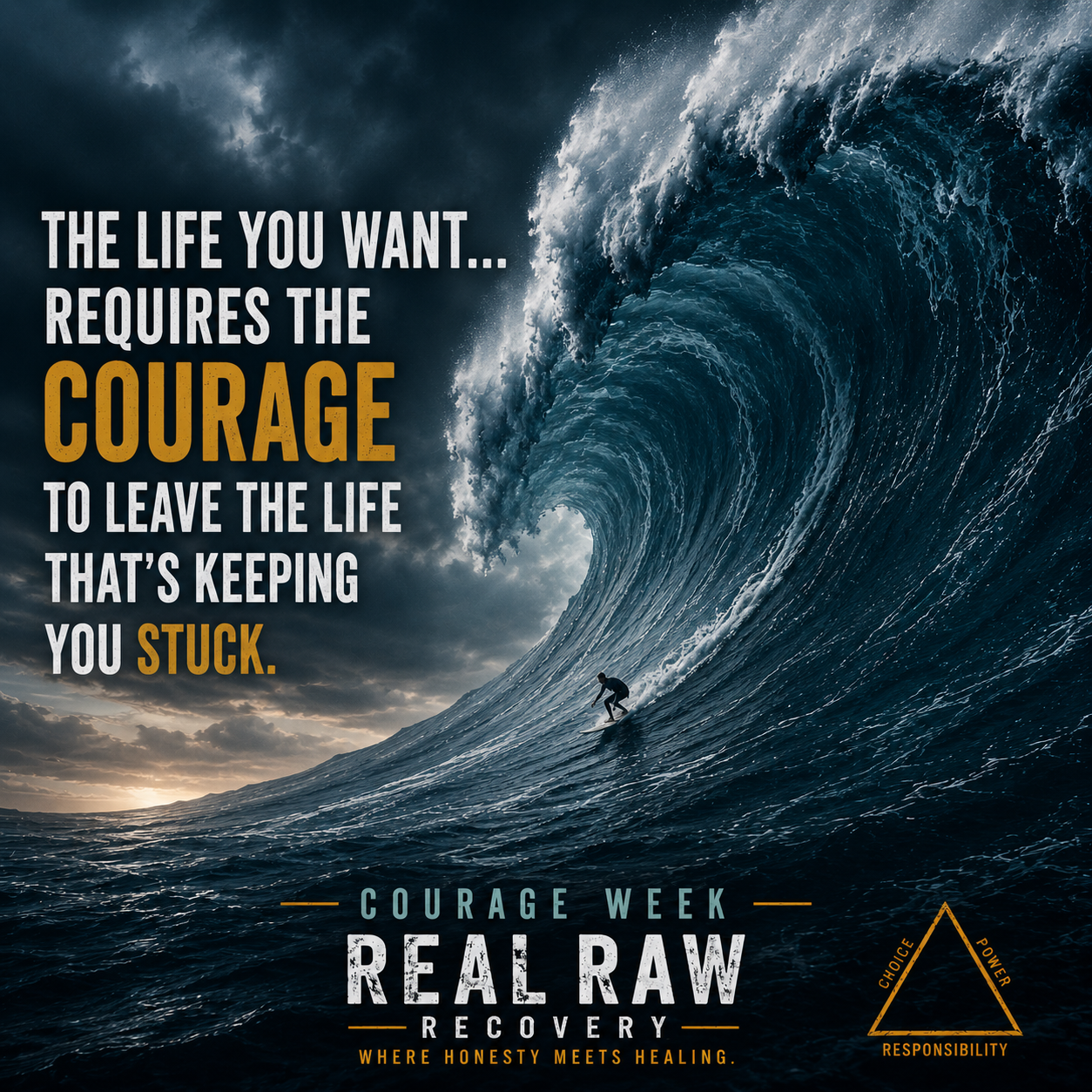
The life you want requires the courage to leave the life that’s keeping you stuck.
For years, many of us lived in fear.
Fear of losing a relationship.
Fear of losing a job.
Fear of not getting the opportunity we wanted.
Fear of rejection.
Fear of failure.
Our lives became controlled by what might happen instead of who we were becoming.
But something changes when you build genuine self-respect.
You begin to realize that you are enough.
Your worth is no longer determined by someone else’s opinion, a paycheck, a title, or whether another person chooses to stay. Those things may still matter, but they no longer define you.
You stand firm in your convictions. You honor your values. You keep your word to yourself. You begin living from a place of integrity instead of insecurity.
That doesn’t mean fear disappears.
Change is still uncomfortable. Walking away from what no longer serves you is still difficult. Choosing growth over comfort will always require courage.
But here’s what changes:
Your strength becomes greater than your fear.
Your resilience becomes stronger than your doubt.
Because every day you look in the mirror, you know the person staring back at you. You trust that person. You respect that person. And eventually, you learn to love that person.
When you know who you are, fear loses its power.
That’s where courage begins.
Look deeper.
Mike
Real Raw Recovery
Where Honesty Meets Healing.